Biographical Influence and Artistic Training
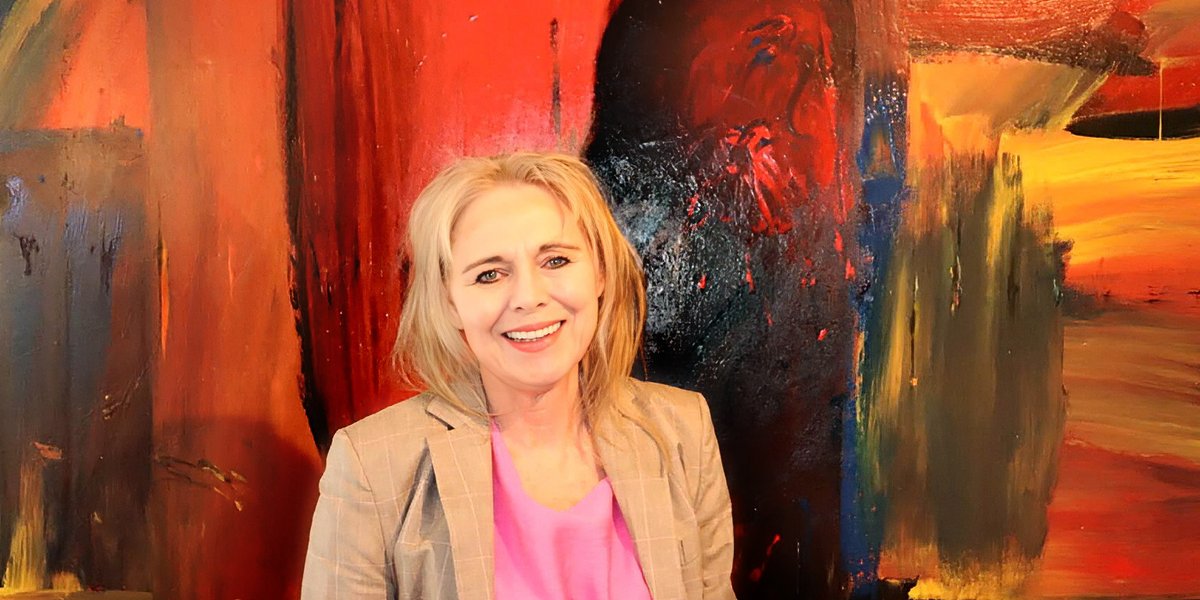
Eva Kaiser's artistic career is characterized by an early closeness to art and an unusually diverse education. Born in Salzburg and trained at the local School of Applied Arts, she initially worked as a designer and advertising graphic artist. This phase gave her a pronounced sense of composition, symbolism, and visual impact – elements that remain subtly present in her later free painting.
A decisive turning point was marked by the intensive turn towards fine arts after the birth of her children. From that point on, Kaiser devoted herself exclusively to painting. Her studies led her in 2002 to the master class of Jacobo Borges, where she engaged with figurative themes, before being admitted to the class of Hermann Nitsch from 2003–2005. There, she worked exclusively in an actionist and abstract manner – an experience that would be formative for her artistic orientation.
Activism, Energy and Materiality
The engagement with Viennese Actionism, particularly with the artistic stance of Hermann Nitsch, forms a central reference point in Eva Kaiser's work. Nitsch himself characterized her art as an "intoxicating grasp of life" – as a deeply lively, sensuous, and worldly art form that consciously distances itself from ascetic or meditative restraint. This assessment points to the fundamental understanding of Kaiser's painting as an energetic act.
Her works are created in a field of tension between control and letting go. Quick gestures, expressive color placements, and dynamic forms characterize the surfaces of the paintings. The materials used – oil, acrylic, mixed techniques, and collages – are not used hierarchically but are understood as equivalent means of open, process-oriented work. The visible traces of creation are an integral part of the image statement.
The non-visible as image content
The content of Eva Kaiser's works revolves around themes such as identity, eros, mysticism, and inner states. It is not about narrative illustration, but about making visible what eludes the direct gaze. Kaiser herself explicitly formulates this claim: She understands art as a reflection of the inner self, the unconscious, the mysterious world behind the facade of the visible.
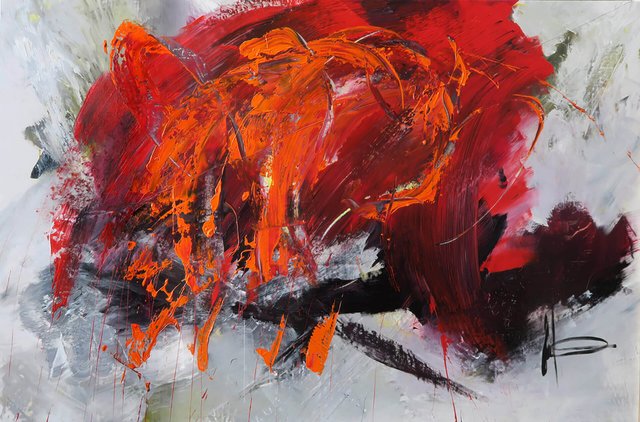
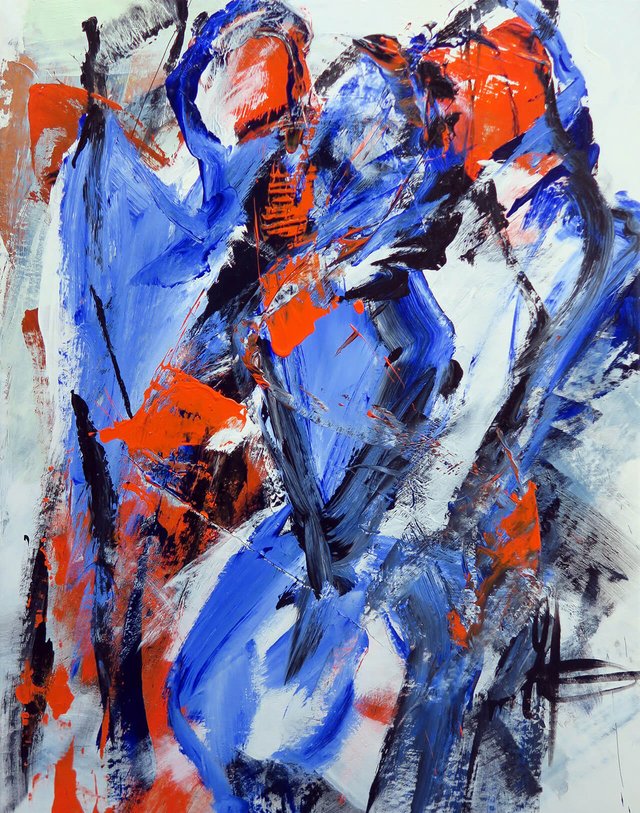
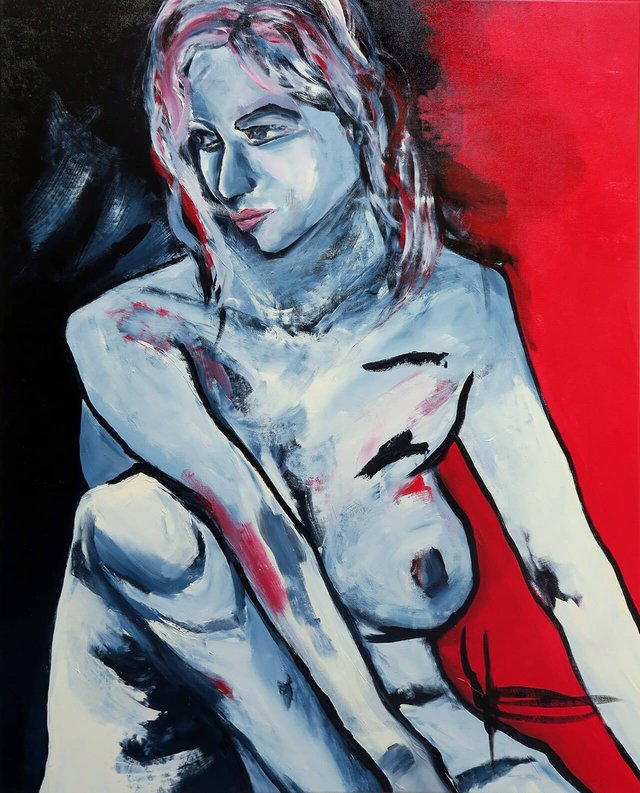
The surface of her paintings acts as the result of a hidden process. What becomes visible is not the starting point, but the condensation of an inner movement. In this sense, her painting is less representational than existential. The viewer is not invited to a quick interpretation, but to a contemplative approach.
Positioning in the contemporary context
Eva Kaiser's work cannot be clearly classified as either abstract or figurative painting. Rather, it consciously moves in between – where forms remain associative and meanings open. This openness gives her works a contemporary relevance, which is also reflected in their presence at exhibitions, art fairs, and in gallery contexts both domestically and abroad.
Her art is not understood as a decorative object, but as an energetic counterpart. In a time characterized by the primacy of the visible and fast images, Eva Kaiser formulates a decisive counter-position: painting as a place of concentration, intensity, and inner truth.
More about the artist
Email address: painting(at)evakaiser(dot)com
Website: www.evakaiser.com
Conclusion
Eva Kaiser stands for a style of painting that does not depict life, but experiences it. Her works are an expression of an artistic attitude that combines action, emotion, and material into a powerful whole. By making the invisible visible, she opens up a space beyond the surface – a space where art becomes an existential experience.